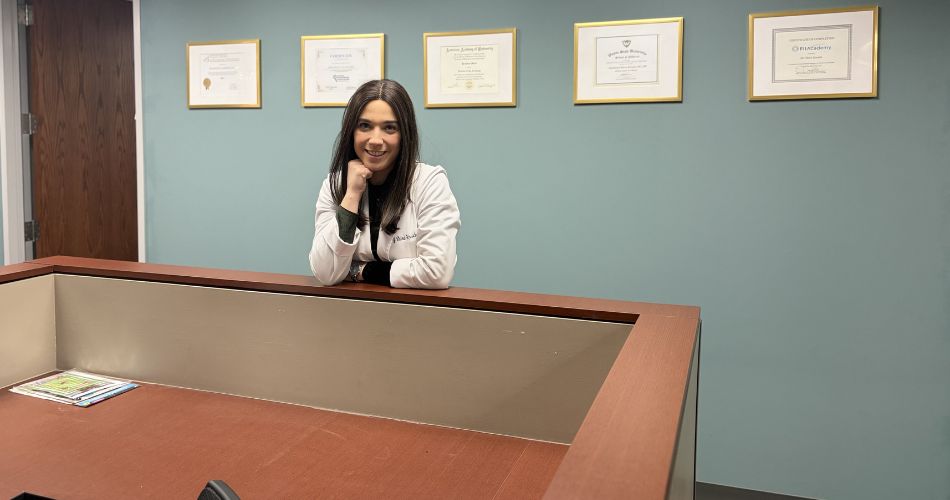
If you live or work in Troy and your dry eye has progressed past what artificial tears can manage — whether from years of screen-heavy engineering work, post-LASIK complications, or systemic conditions — you may be a candidate for treatments that address the underlying disease rather than just the symptoms. Dr. Y. Shira Kresch, OD MS is a fellowship-trained dry eye and scleral lens specialist 18 minutes south of the Big Beaver corridor, offering FDA-cleared IPL, RF, and LLLT alongside specialty scleral lens fitting.
From the Big Beaver Rd / Crooks Rd area in Troy, head west on Big Beaver Road. Continue west until Big Beaver becomes 16 Mile Road, then turn left (south) onto Telegraph Road. Continue south past Square Lake, Long Lake, and 12 Mile to West 10 Mile Road. Turn left (east). Our office is on the south side at 17000 W 10 Mile Rd, Suite 151.
Alternate route via I-75 / I-696: take I-75 south to I-696 west, exit at Telegraph Rd south, then turn east onto 10 Mile.
Drive time: approximately 18 minutes outside rush hour. Free parking on-site.
Troy has one of the heaviest concentrations of engineering, automotive R&D, and white-collar professional work in Metro Detroit. That demographic produces a distinctive pattern of dry eye disease that we see consistently from Troy patients:
Screen-intensive evaporative dry eye. Engineers, CAD designers, and analysts spend 8–10 hours per day in focused screen work — often across multiple monitors. Blink rate drops sharply during sustained focus, incomplete blinks accumulate, and the meibomian glands at your eyelid margin lose the mechanical pumping action that releases oil into your tears. Over years, this leads to structural meibomian gland dysfunction — a treatable, progressive condition that artificial tears cannot reverse. IPL and RF address the underlying gland obstruction directly.
Post-LASIK and post-surgical dry eye. Many Troy professionals had LASIK or PRK in their 20s and 30s and are now in their 40s and 50s noticing dryness, fluctuating vision, or end-of-day blur. Refractive surgery permanently severs corneal nerves, which can reduce tear film homeostatic feedback for years. We see this pattern often and it responds well to targeted treatment.
Contact lens intolerance. A significant portion of Troy patients are working contact lens wearers who find their lenses uncomfortable by mid-afternoon. The reason is usually evaporative dry eye that develops underneath the lens — and the fix isn’t switching brands. It’s diagnosing and treating the actual condition.
For Troy-area patients who also need keratoconus management or specialty contact lens fitting — scleral, hybrid, or Rose K lenses — our affiliated practice Michigan Contact Lens is the corneal specialty destination. Many of our dry eye patients also see Dr. Kresch there for the specialty contact lens side of their care — the same doctor across both practices.
Common questions from Troy, MI patients about visiting 1-800-Dry-Eyes.
About 20 minutes from central Troy. Take I-696 west to Telegraph, then south to 10 Mile — the office is easy to find. Patients coming from the Somerset Collection or the Big Beaver corridor often make it part of an existing trip into Southfield.
Yes, regularly. Troy has several excellent general optometry practices but no dedicated dry eye specialty clinic — patients who need diagnostic imaging, in-office treatment, or a structured workup typically come to us in Southfield.
We do not offer evening or weekend appointments at this time; our hours are Monday-Friday, 9 AM to 5 PM. We do our best to accommodate working professionals with early morning slots when possible. Call 1-800-DRY-EYES to discuss scheduling.
Treatment depends entirely on what is driving your dry eye. We offer IPL, radiofrequency, low-level light therapy, scleral lens fittings, and combined protocols. The right choice — or combination — emerges from your diagnostic workup, not from guessing.
The diagnostic portion is typically billed to your medical insurance, and we are in-network with most major carriers. In-office treatments like IPL and RF are considered elective and are not insurance-covered; CareCredit and other financing options are available.
18 minutes south on Telegraph. Free parking. Most patients start with a comprehensive evaluation to identify what's actually driving their symptoms.